
Executive Summary: Traditional adhesive labeling creates "Operational Rigidity." This guide examines how magnetic identification transforms racking into a reconfigurable asset, eliminating labor-intensive residue removal and solving the adhesive failure common in cold-chain logistics.
The Hidden Cost of "Permanent" Identification
Traditional identification methods, like permanent labels, may seem reliable, but they come with hidden costs that can hinder operational efficiency. Once affixed, these labels become a long-term commitment. If you need to change or relocate inventory, removal often damages the substrate or requires additional labor.
This problem not only incurs extra costs but also leads to errors in inventory management. When labels are misplaced, it can result in mispicking and wasteful time spent searching for items. Understanding these hidden costs is essential for making informed decisions about warehouse systems.
Asset Preservation: Protecting Your Investment
Investing in magnetic racking labels also supports long-term asset preservation. The impact of frequent use of scrapers and chemical solvents can damage the powder coating on your high-bay racking systems.
Magnetic labels eliminate "Label Scarring." By avoiding aggressive adhesives and mechanical scraping, you preserve the structural integrity and resale value of your high-bay racking systems. This approach ensures that your equipment remains in peak condition while maximizing its lifespan.
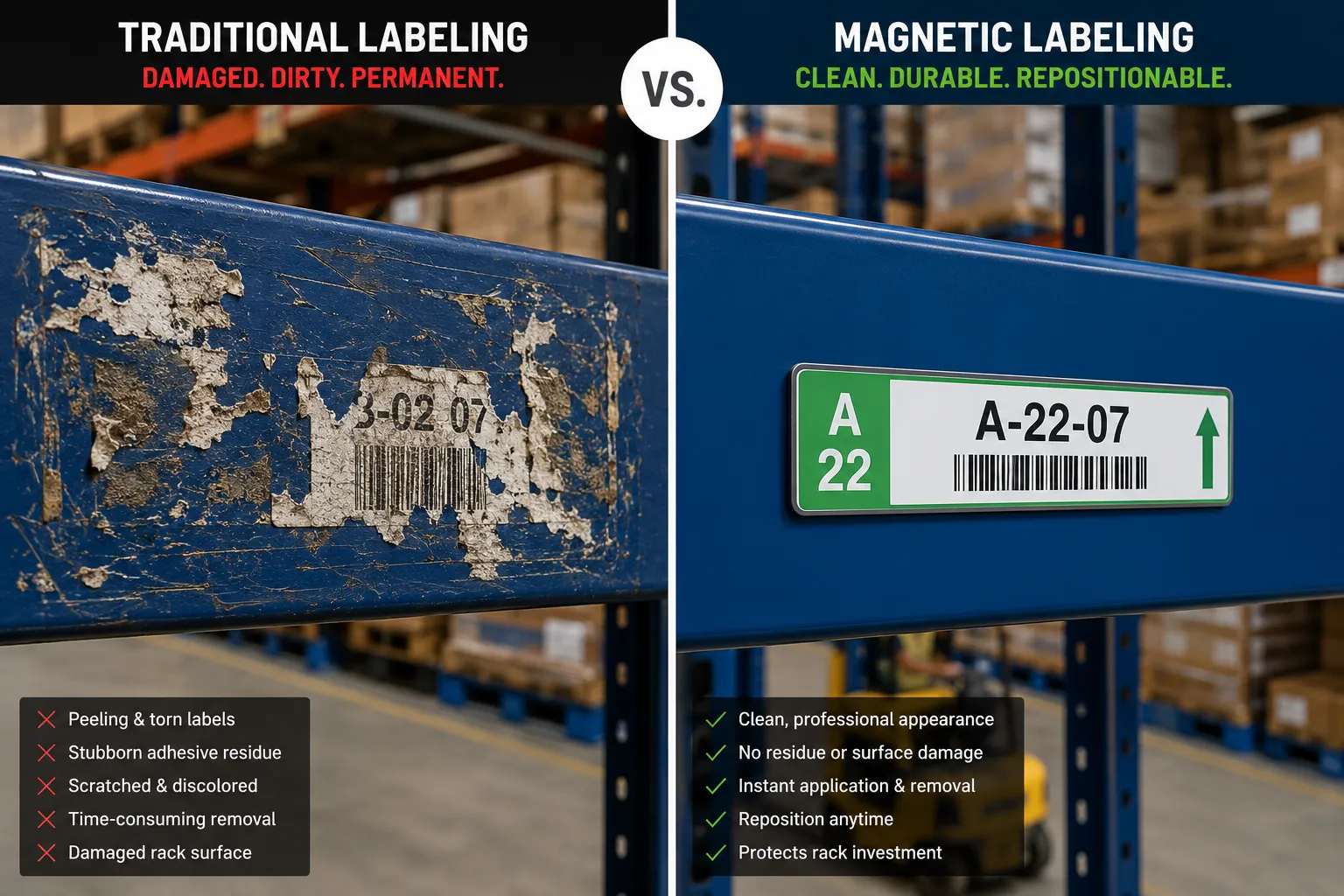
Magnetic Labels: Turning Racking into Dynamic Assets
The Challenge: Standard labels become static and unyielding.
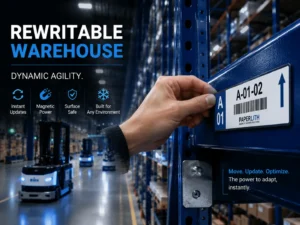
The Magnetic Solution: Magnetic labels are designed to be easily repositionable, transforming racking systems into dynamic assets. Unlike traditional adhesive labels, magnetic options allow for rapid reorganization without damage.
Our magnetic carriers feature a top-coated synthetic face-stock optimized for high-resolution thermal transfer printing. This ensures that barcodes remain crisp and maintain a high contrast ratio for long-range scanning, even under harsh LED warehouse lighting. Engineered with high-energy anisotropic magnet backing, our labels provide superior pull force, ensuring a secure grip on powder-coated steel racks while remaining easy to reposition by hand. This flexibility supports agile warehousing practices, enabling quicker adjustments aligned with changing inventory needs. The pull force allows for significant resistance to sliding, ensuring that even minor vibrations from forklifts or air currents won’t displace the labels.
The Cold Chain Solution: Deep Dive into Physics
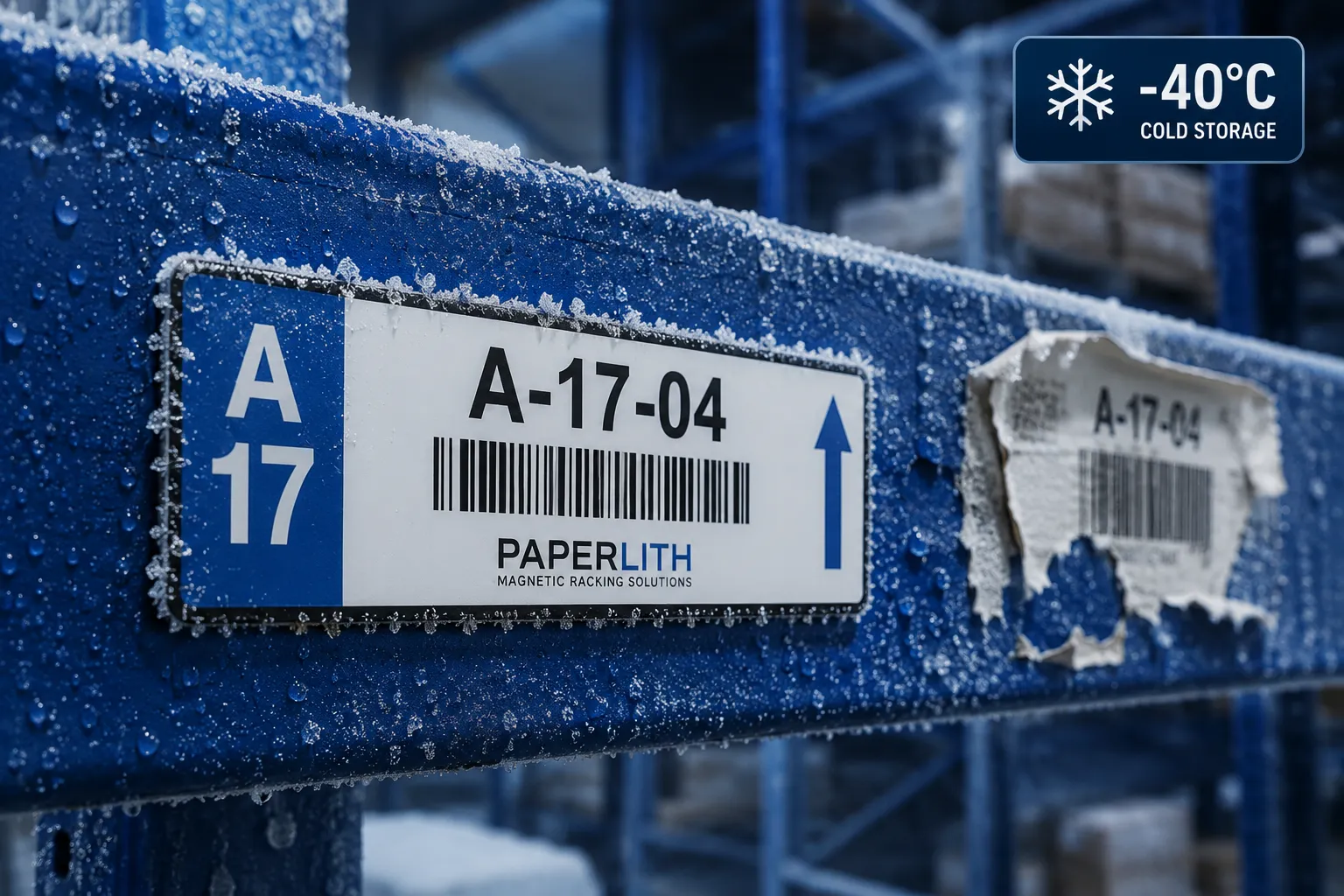
In cold chain logistics, traditional labels can fail under low-temperature conditions. Adhesives can lose their grip, becoming brittle and ineffective.
The Challenge: Adhesive failures and label degradation compromise operations.
The Magnetic Solution: Standard adhesives reach their glass transition point in sub-zero environments, becoming brittle and losing molecular tack. In contrast, magnetic identification relies on constant physical force, ensuring labels remain secure at temperatures as low as $-40^circtext{C}$ without the risk of "pop-offs" caused by frost or condensation.Magnetic labels represent the first tier of a rewritable physical environment, where location data can be 'overwritten' simply by moving the carrier, requiring zero new materials.
This superior stability reinforces the reliability of magnetic labels in cold-storage environments, mitigating risks associated with temperature-induced adhesive failure.
Operational ROI: Labor Savings Over Material Costs
Investing in magnetic racking labels offers not only material savings but significant labor savings too. In the U.S. and Europe, labor costs far exceed the costs of the labels themselves. Therefore, improving re-slotting efficiency can lead to substantial operational gains.
Re-slotting a typical warehouse aisle with pressure-sensitive labels can take hours of scraping and cleaning. With magnetic carriers, the same task is reduced to minutes, allowing your labor force to focus on high-value fulfillment rather than facility maintenance.
Financial Logic: Unlike adhesive labels that degrade after a single use, PaperLith magnetic systems are built with an anti-aging magnetic core that retains constant magnetic flux for over a decade. This transitions your labeling budget from a recurring Opex drain to a one-time Capex investment.
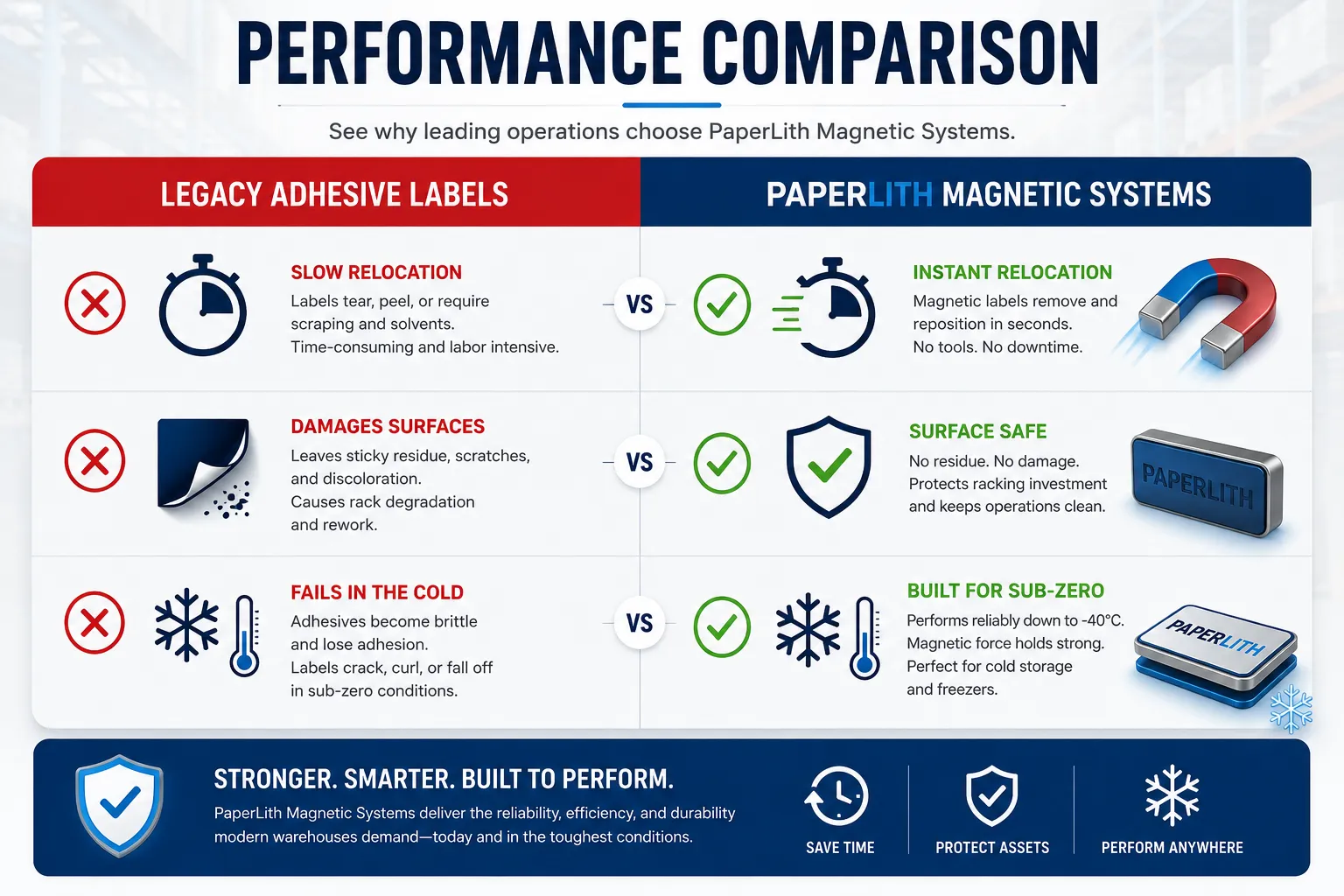
Performance Comparison Table
| Metric | Adhesive-Based Labels | PaperLith Magnetic Systems |
|---|---|---|
| Relocation Speed | Slow (Scrape & Clean) | Instant (Lift & Move) |
| Residue/Damage | High (Sticky residue) | Zero (Surface Safe) |
| Cold Storage | High failure risk | Optimal (Thermally Stable) |
| Financial Nature | Opex (Consumable) | Capex (Reusable Asset) |
This table highlights the performance differences between adhesive-based labels and PaperLith magnetic systems, emphasizing the advantages of magnetic solutions in efficient warehouse operations.
The Consultative Approach
Are you ready to elevate your warehouse efficiency through the strategic use of magnetic racking labels? At PaperLith, we offer tailored solutions aimed at optimizing your inventory systems.
Magnetism provides the physical foundation for a truly Rewritable Warehouse. Stay tuned for our next feature, where we explore how Block-Out technology enables instant information overwriting without the need for manual cleaning.
Request a Consultation today to explore how magnetic labels can drive operational improvements in your facility. Take the first step towards reducing costs and enhancing flexibility by contacting us for a personalized audit of your racking needs.


.png)