
Cold chain logistics is critical for maintaining product integrity. However, many businesses face significant thermal barcode failures. Understanding the underlying causes is essential for improving operational efficiency.

The Condensation Barrier: Tackling the Micro-Moisture Layer
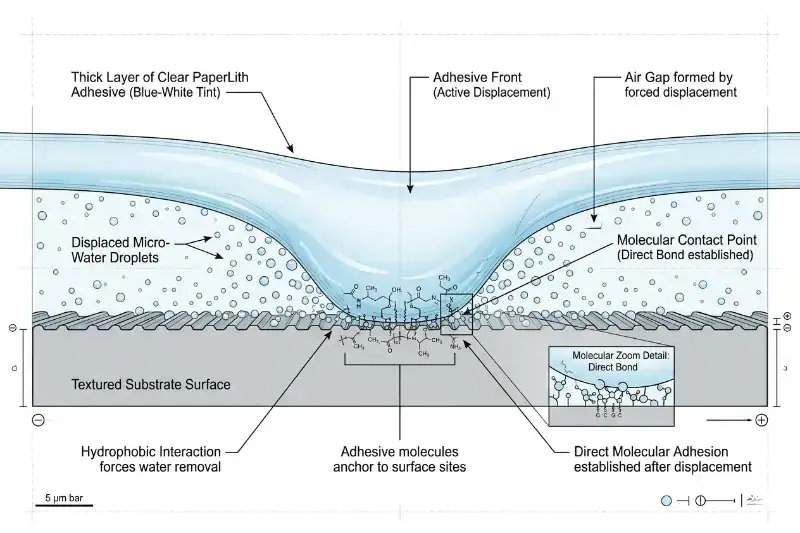
Moisture poses a serious threat to adhesive performance in cold environments. When transitioning from ambient temperatures to cold storage, a microscopic layer of condensation forms rapidly. Standard adhesives falter under these conditions(https://www.umass.edu/bct/wp-content/uploads/2018/05/Crosby-BCT-Lecture-April-2018.pdf), as they sit atop this water barrier, leading to 'float-off.'
PaperLith addresses this issue with a high-tack initial bond, measured at over 18N/25mm (FTM1 standard), which physically displaces moisture to form a direct molecular connection with the substrate. This technology ensures that our labels remain adhered even in the most demanding cold chain scenarios.
The Science of Tg: Why We Engineer for -35°C Flexibility
Understanding the Glass Transition Temperature (Tg) is crucial in selecting the right adhesive for cold environments.Standard hot-melt rubber adhesives have a Tg around -5°C.(https://www.dyna-techadhesives.com/new-markets/hot-melt/dynahm/) At this temperature, they transition into a non-tacky solid, rendering them ineffective for cold applications. In contrast, our bespoke acrylic Cold-Chain Series maintains an impressive Tg of -35°C. This ensures that the polymer chains remain fluid and 'sticky,' capable of holding firm even in deep-freeze blast tunnels.
Thermal Shock & Dynamic Resistance
Thermal shocks present a real challenge for thermal barcodes, especially when moving from a -20°C freezer to a +30°C loading dock. Poor-quality thermal papers often lack the necessary protective top-coat, causing chemical leuco dyes to react to fluctuations in ambient humidity and heat(https://pmc.ncbi.nlm.nih.gov/articles/PMC10007136/). This leads to background fogging, which can result in Optical Density (OD) levels exceeding 1.2, rendering the barcodes unreadable(https://www.iso.org/standard/65577.html).
Our advanced protective coatings mitigate this issue by creating a robust defense against thermal shock. This ensures consistent readability and reliability throughout the transportation process.
Substrate Incompatibility: High Coat Weight for Robust Bonding
Not all surfaces are compatible with thermal labels. Standard adhesives struggle with recycled boxes and waxy surfaces, leading to detachment. Our Cold-Chain adhesives, featuring a high coat weight of 26 g/m², are engineered to penetrate the short fibers of recycled materials. While the industry standard hovers around 18-20 g/m²(https://nepis.epa.gov/Exe/ZyPURL.cgi?Dockey=000020YY.TXT), PaperLith increases this by nearly 30% to ensure deep fiber penetration. This high interlock capability guarantees that labels firmly adhere, becoming an integral part of the packaging material.
Physical Abrasion: Long-Haul Friction and Scanning Failures
Transportation often subjects labels to physical abrasion. When barcodes endure scratches or wear, their scanning reliability seriously diminishes. Our labels are designed with durability in mind, ensuring they withstand the rigors of handling and transport without sacrificing performance.
We integrate a high-density protective top-coat that acts as a sacrificial layer against friction, maintaining barcode ANSI scannability even after thousands of miles of transit vibrations.

Insights
Addressing the challenges posed by cold chain logistics requires advanced label technology that meets high-performance standards. PaperLith's Cold-Chain Pro labels are optimized to function seamlessly in extreme conditions.
Performance Reference Table
| Technical Specification | Standard Logistics Label | PaperLith Cold-Chain Pro |
|---|---|---|
| Minimum Application Temp | +5°C to +10°C | -20°C (-4°F) |
| Service Temperature Range | -10°C to +50°C | -45°C to +60°C |
| Adhesive Coat Weight | 18 - 20 g/m² | 24 - 26 g/m² (High-Interlock) |
| Moisture Resistance | Low (Peels when damp) | Excellent (Water-Displacing) |
| Scan Reliability | ANSI Grade C/D | ANSI Grade A (High-Contrast) |
Not sure about your substrate's compatibility? Contact PaperLith technical team for a complimentary Adhesive Stress Test. We’ll verify the bond strength against your specific temperature curve before you place a bulk order.Or you can check out more about PaperLith premium Labels(https://paperlith.com/industrial-label-manufacturer/).

.png)